

Elecnova · Liquid cooling · Schrank
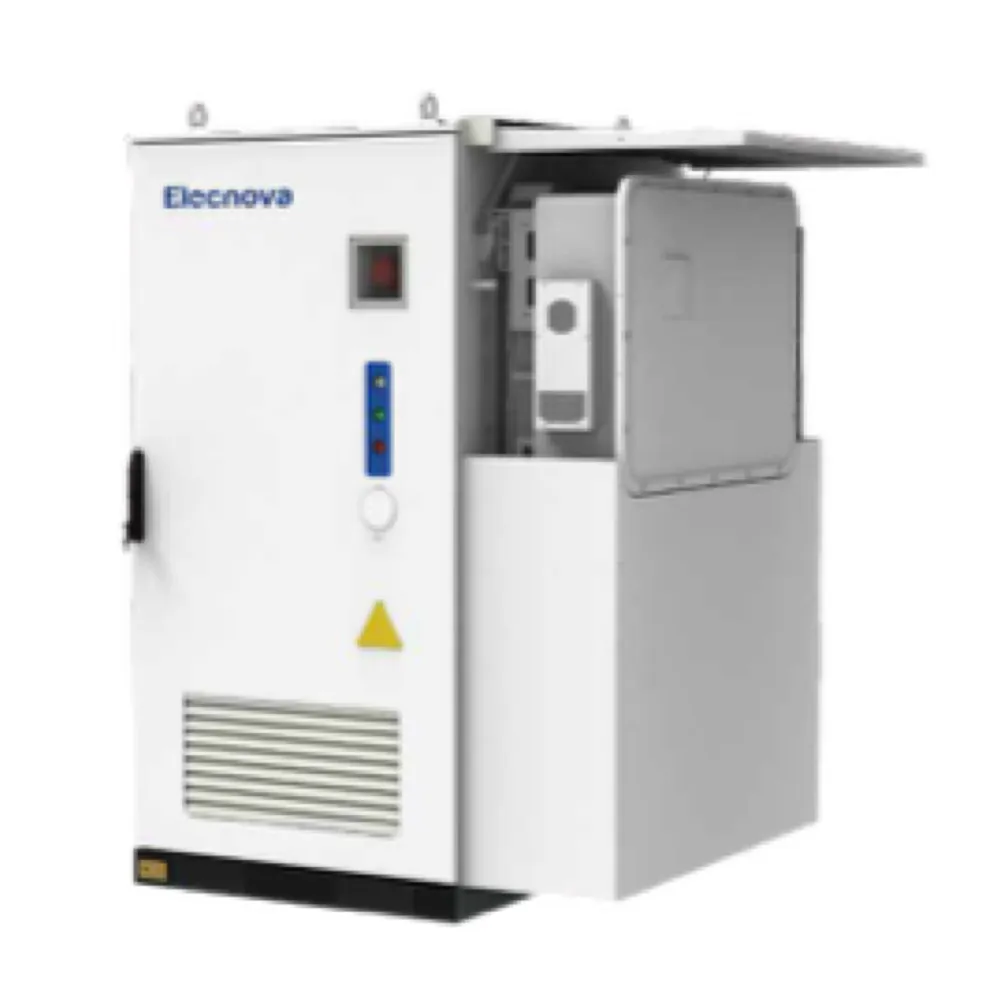
Elecnova ECO-B261LP-2H
Liquid-cooled hybrid battery cabinet: 261 kWh, direct PV input up to 250 kW across 10 MPPTs, 75 to 125 kW AC depending on the hybrid inverter.
Technical data
| System | |
|---|---|
| Nominal capacity | 261 kWh |
| Cell type | LFP 314 Ah |
| Cooling | Liquid cooling |
| Form factor | Schrank |
| Cycle life | 8,000 |
| Max. depth of discharge | 100 % |
| Efficiency (RTE) | 90 % |
| Grid & power | |
| AC power | 125 kW |
| Grid voltage | 400 V |
| On/off-grid switching | No |
| Direct PV input | Yes |
| Installation | |
| Dimensions (W×D×H) | 1850×1350×2100 mm |
| Weight | 2.6 t |
| IP rating | IP55 |
| Fire protection | Aerosol |
Technical data per the manufacturer's datasheet; binding values depend on configuration and project.
ECO-B261LP-2H — a battery cabinet for PV-plus-storage
The ECO-B261LP-2H is a liquid-cooled battery cabinet with 261 kWh, an embedded energy management system and aerosol fire suppression. It is not an all-in-one system: the inverter does not sit inside the cabinet but alongside it, as a hybrid unit handling the PV input, the grid connection and the operating strategy.
That sounds like a drawback and often is not one on a new PV installation. A hybrid inverter couples the array to the storage system on the DC side instead of routing it through a separate PV inverter and the shared AC bus. That saves one conversion step and one device.
Five power configurations
Capacity is identical across the variants; what differs is the inverter in front of it:
| PV input | AC power | DC/AC ratio |
|---|---|---|
| 150 kW | 75 kW | 2.0 |
| 160 kW | 80 kW | 2.0 |
| 200 kW | 99.9 kW | 2.0 |
| 200 kW | 100 kW | 2.0 |
| 250 kW | 125 kW | 2.0 |
The step from 99.9 to 100 kW is not a typo. In several European grid codes 100 kW is a threshold above which additional requirements apply — the 99.9 kW variant exists to stay just below it. Whether that matters at a given site is for the grid operator to decide.
The consistent DC/AC ratio of 2.0 stands out: the PV generator may be sized at twice the AC power. For a system that absorbs the surplus anyway this makes sense — the midday peak is not clipped away but stored.
Ten MPPT trackers
The PV input works with ten independent MPPT trackers at 150 to 950 V and 42 A per tracker. That is unusually many for this class and in practice matters more than the raw input rating: roof areas with different orientation, pitch or shading can be run separately, without the weakest string dragging the others down.
Footprint
The datasheet gives two sets of dimensions. The cabinet itself stands on 1,050 × 1,350 mm — the roughly 1.4 m² the manufacturer advertises. The overall figure of 1,850 × 1,350 × 2,100 mm includes the inverter bay attached to the side. Site planning should use the overall figure, the foundation the smaller one.
Key specifications
| Feature | ECO-B261LP-2H |
|---|---|
| Battery capacity | 261.25 kWh (5 × 52.25 kWh) |
| Cell chemistry | LFP, 314 Ah |
| Configuration | 1P260S |
| Nominal DC voltage | 832 V (728–936 V) |
| Charge/discharge rate | 0.5 P |
| Depth of discharge | 100 % (at 25 ± 2 °C) |
| Cycle life | ≥ 8,000 cycles |
| Round-trip efficiency | up to 90 % |
| AC power | 75 / 80 / 99.9 / 100 / 125 kW |
| Grid voltage | 400 V, 3W+N+PE, 50/60 Hz |
| PV input | up to 250 kW, 150–950 V, 10 MPPT |
| Cooling | active liquid cooling |
| Operating temperature | −25 to 55 °C (derating above 45 °C) |
| Ingress protection | IP55 |
| Corrosion class | C4 (C5 optional) |
| Fire suppression | aerosol |
| Communication | Modbus TCP/IP |
| Dimensions (W×D×H) | 1,850 × 1,350 × 2,100 mm overall |
| Weight | 2,600 kg |
| Standards | UN 38.3, IEC 62619, IEC 63056, IEC 62477-1, IEC 61000-6-2/4 |
| Grid codes | EN 50549-1/-2, VDE-AR-N 4105, G99, NRS 097, C10/11 |
Where it fits
The B261 is the right choice when a larger PV array is being built or extended and storage is planned in from the start. Where an existing AC-coupled array is already running and is not to be rebuilt, an all-in-one system with its own PCS — the ECO-E261LP-2A at the same capacity, for instance — is usually the more direct route.
Every project has to settle which hybrid inverter is used. It determines AC power, PV input rating and the operating modes of the whole system — the cabinet alone does not fix those.
Frequently asked questions
What is the ECO-B261LP-2H?
A liquid-cooled battery cabinet with 261 kWh, an embedded EMS and aerosol fire suppression. It is paired with a hybrid inverter that connects PV and grid — unlike an all-in-one system with a built-in PCS.
Which power configurations are available?
Five configurations from 75 to 125 kW AC, depending on the hybrid inverter used. The PV input scales with them: 150 kW at 75 kW AC up to 250 kW at 125 kW AC. Battery capacity stays at 261 kWh in every variant.
How much PV can be connected directly?
Up to 250 kW of DC-coupled PV across ten MPPT trackers with a voltage range of 150 to 950 V. That allows several differently oriented roof areas to be run on separate trackers.
Which grid codes does the datasheet list?
EN 50549-1 and -2, VDE-AR-N 4105, G99, NRS 097 and C10/11. For a project in Austria, EN 50549-1 is the relevant reference standard; the actual registration is settled with the grid operator case by case.