

SAV · Air cooling · Schrank
SAV Storage Elf L1-8
Fully configured all-in-one C&I storage cabinet: 128 kWh and 64 kW on 1.2 m² of floor space — the largest Storage Elf L1 variant.
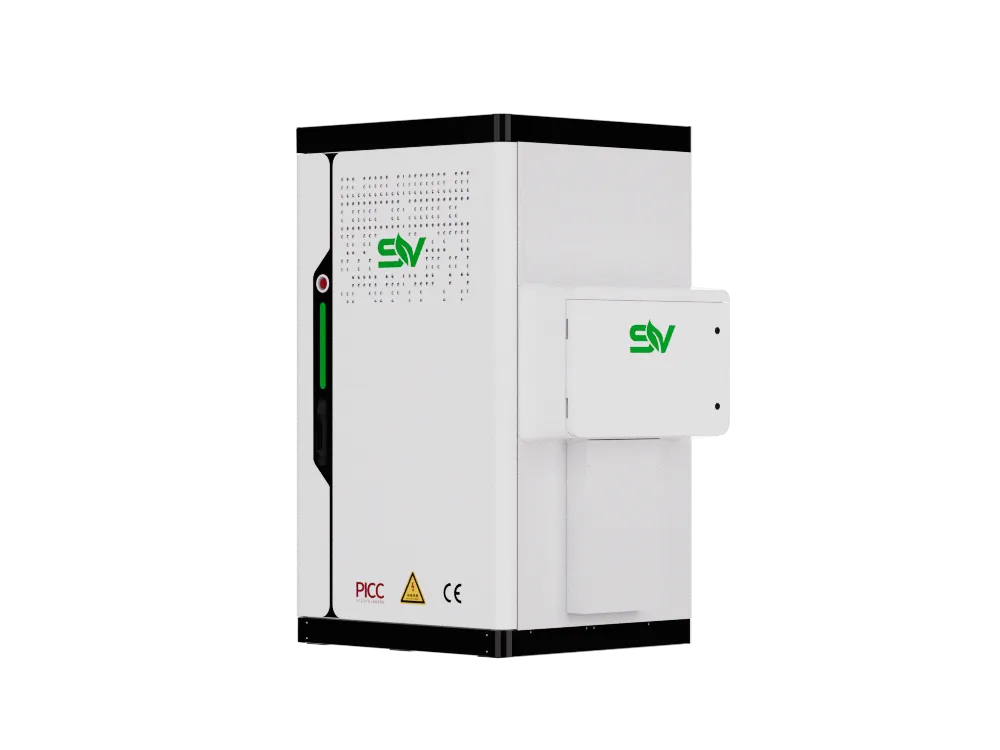
Technical data
| System | |
|---|---|
| Nominal capacity | 128 kWh |
| Cell type | LFP |
| Cooling | Air cooling |
| Form factor | Schrank |
| Efficiency (RTE) | 90 % |
| Grid & power | |
| AC power | 64 kW |
| Grid voltage | 400 V |
| On/off-grid switching | Yes |
| Direct PV input | Yes |
| Installation | |
| Dimensions (W×D×H) | 1150×1050×2000 mm |
| Weight | 1.6 t |
| IP rating | IP55 |
| Fire protection | Rauch- und Wärmemelder, Aerosol |
Technical data per the manufacturer's datasheet; binding values depend on configuration and project.
Storage Elf L1-8 — the full build
The Storage Elf L1-8 is the largest configuration in the series: eight battery packs, 128 kWh, 64 kW of rated power. It uses the cabinet to capacity without taking up more space than the L1-5.
The full build is right where the storage system handles several tasks at once or where charging infrastructure is involved. A DC fast charger draws power in a pattern that strains any grid connection: short, high and hard to predict. A storage system that buffers those peaks can replace a connection upgrade, or at least defer it — and that takes power and energy at the same time.
The second typical case is autonomy. Where defined loads are to keep running during an outage, capacity determines how long the bridge lasts. 128 kWh is not a promise but a starting figure: which loads are supplied for how long follows from their power draw and from the protection and transfer equipment.
The series at a glance
| Variant | Capacity | Rated on-grid power | Battery voltage | Weight |
|---|---|---|---|---|
| L1-5 | 80 kWh | 40 kW | 224–292 V | ≤ 1,270 kg |
| L1-6 | 96 kWh | 48 kW | 269–350 V | ≤ 1,380 kg |
| L1-7 | 112 kWh | 56 kW | 314–409 V | ≤ 1,490 kg |
| L1-8 (this page) | 128 kWh | 64 kW | 358–467 V | ≤ 1,600 kg |
All four variants share the same cabinet, the same footprint and the same 100 kW inverter. They differ solely in the number of battery packs — each pack contributes 16 kWh and 8 kW.
Where several operating modes coincide, their order needs to be defined. A storage system expected to buffer PV, shave peaks and hold a backup reserve at the same time has to know which task takes precedence — a question of EMS parameterisation, not of hardware.
Configuration options
Two functions of the series depend on configuration and are not part of every delivery:
- Direct PV integration — the MPPT input for up to 70 kW of DC-coupled PV is listed as an option in the manufacturer’s datasheet. Below 438 V of string voltage the input operates with derating.
- Grid/island transfer (STS) — the backup power function is likewise listed as an option in the datasheet, while the manufacturer’s website describes it as a standard function.
We clarify both with the manufacturer before quoting. Either way, backup power is not a product feature but a project. Grid disconnection, protection equipment, load allocation, inrush currents and bridging time are assessed for each site.
Frequently asked questions
How much capacity and power does the Storage Elf L1-8 have?
128 kWh of nominal LFP capacity and 64 kW of rated on-grid power at 400 V. The system's maximum AC power is 100 kW. Binding figures depend on configuration and project.
How much space does the L1-8 need?
The cabinet measures 1,150 × 2,000 × 1,050 mm (W×H×D) and weighs at most 1,600 kg. The footprint of roughly 1.2 m² is identical across all four variants of the series.
Can a PV array be connected directly?
The series can take up to 70 kW of DC-coupled PV through an MPPT input, which can make a separate PV inverter unnecessary. The input is listed as an option in the manufacturer's datasheet — we confirm the scope of delivery before quoting.
Is the L1-8 suitable for backup power?
The series includes a grid/island transfer switch, which is part of the delivery depending on configuration. Even then backup power remains a planning task: grid disconnection, protection equipment, load allocation, inrush currents and bridging time are assessed for each site.