

SAV · Air cooling · Schrank
SAV Storage Elf L1-5
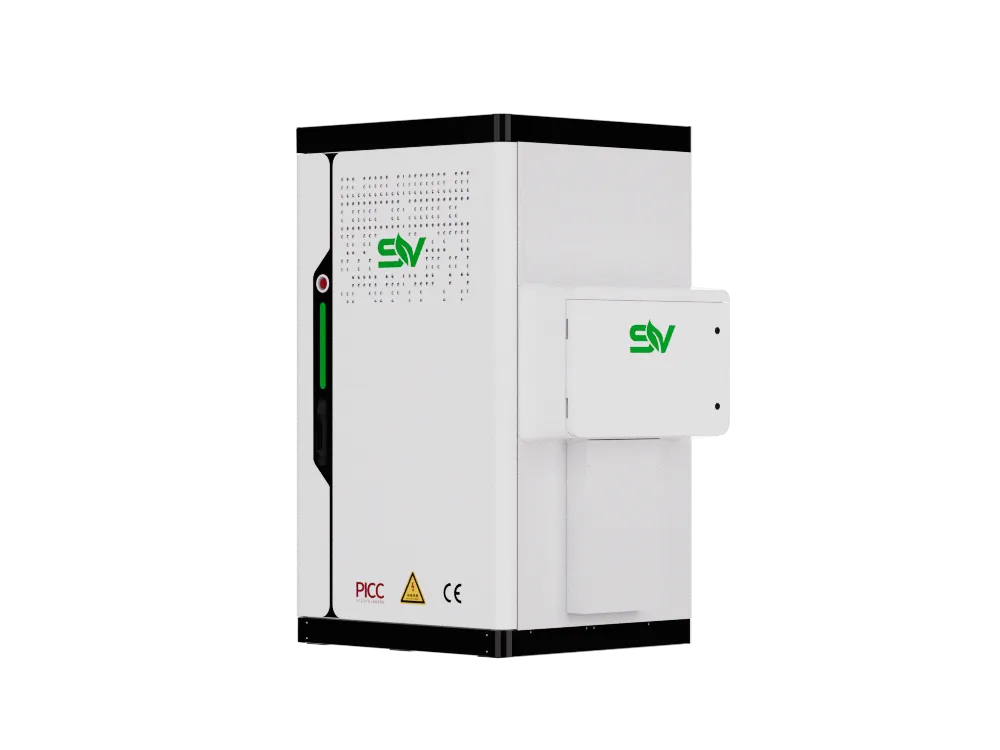
Compact all-in-one C&I storage cabinet: 80 kWh and 40 kW on 1.2 m² of floor space — the entry size of SAV's Storage Elf L1 series.
Technical data
| System | |
|---|---|
| Nominal capacity | 80 kWh |
| Cell type | LFP |
| Cooling | Air cooling |
| Form factor | Schrank |
| Efficiency (RTE) | 90 % |
| Grid & power | |
| AC power | 40 kW |
| Grid voltage | 400 V |
| On/off-grid switching | Yes |
| Direct PV input | Yes |
| Installation | |
| Dimensions (W×D×H) | 1150×1050×2000 mm |
| Weight | 1.3 t |
| IP rating | IP55 |
| Fire protection | Rauch- und Wärmemelder, Aerosol |
Technical data per the manufacturer's datasheet; binding values depend on configuration and project.
Storage Elf L1-5 — the entry size
The Storage Elf L1-5 is the smallest of the four configurations: 80 kWh of capacity and 40 kW of rated power in an air-cooled all-in-one cabinet that occupies roughly 1.2 m².
It suits businesses deploying storage for the first time — trades, smaller production sites, agriculture, hospitality. The purpose is usually well defined: shift a PV surplus into the evening, or absorb a recurring load peak. The entry size often covers either case and ties up less capital than a system that would not be fully used for years.
Within the series the L1-5 has one peculiarity: relative to its rated power it allows the highest short-term overload, because the same 100 kW inverter works against the smallest battery. For sites with short, high load peaks but modest overall energy demand, the smallest variant can therefore be the right one.
About the designation
SAV lists the 80 kWh variant without a model designation of its own. “L1-5” follows the manufacturer’s model key, which names the series after the number of battery packs — five packs of 16 kWh each. We confirm the designation at the time of ordering.
The series at a glance
| Variant | Capacity | Rated on-grid power | Battery voltage | Weight |
|---|---|---|---|---|
| L1-5 (this page) | 80 kWh | 40 kW | 224–292 V | ≤ 1,270 kg |
| L1-6 | 96 kWh | 48 kW | 269–350 V | ≤ 1,380 kg |
| L1-7 | 112 kWh | 56 kW | 314–409 V | ≤ 1,490 kg |
| L1-8 | 128 kWh | 64 kW | 358–467 V | ≤ 1,600 kg |
All four variants share the same cabinet, the same footprint and the same 100 kW inverter. They differ solely in the number of battery packs — each pack contributes 16 kWh and 8 kW.
Where the L1-5 is not the right choice: if consumption or the PV array is likely to grow substantially over the next few years, moving up to the L1-6 or L1-7 is usually the cheaper decision — floor space, foundation and grid connection are identical across all four variants.
Configuration options
Two functions of the series depend on configuration and are not part of every delivery:
- Direct PV integration — the MPPT input for up to 70 kW of DC-coupled PV is listed as an option in the manufacturer’s datasheet. Below 438 V of string voltage the input operates with derating.
- Grid/island transfer (STS) — the backup power function is likewise listed as an option in the datasheet, while the manufacturer’s website describes it as a standard function.
We clarify both with the manufacturer before quoting. Either way, backup power is not a product feature but a project. Grid disconnection, protection equipment, load allocation, inrush currents and bridging time are assessed for each site.
Frequently asked questions
How much capacity and power does the Storage Elf L1-5 have?
80 kWh of nominal LFP capacity and 40 kW of rated on-grid power at 400 V. The system's maximum AC power is 100 kW. Binding figures depend on configuration and project.
How much space does the L1-5 need?
The cabinet measures 1,150 × 2,000 × 1,050 mm (W×H×D) and weighs at most 1,270 kg. The footprint of roughly 1.2 m² is identical across all four variants of the series.
Can a PV array be connected directly?
The series can take up to 70 kW of DC-coupled PV through an MPPT input, which can make a separate PV inverter unnecessary. The input is listed as an option in the manufacturer's datasheet — we confirm the scope of delivery before quoting.
Is the L1-5 suitable for backup power?
The series includes a grid/island transfer switch, which is part of the delivery depending on configuration. Even then backup power remains a planning task: grid disconnection, protection equipment, load allocation, inrush currents and bridging time are assessed for each site.