

SAV · Air cooling · Schrank
SAV Storage Elf L1-6
All-in-one C&I storage cabinet with 96 kWh and 48 kW on 1.2 m² of floor space — the balanced configuration of SAV's Storage Elf L1 series.
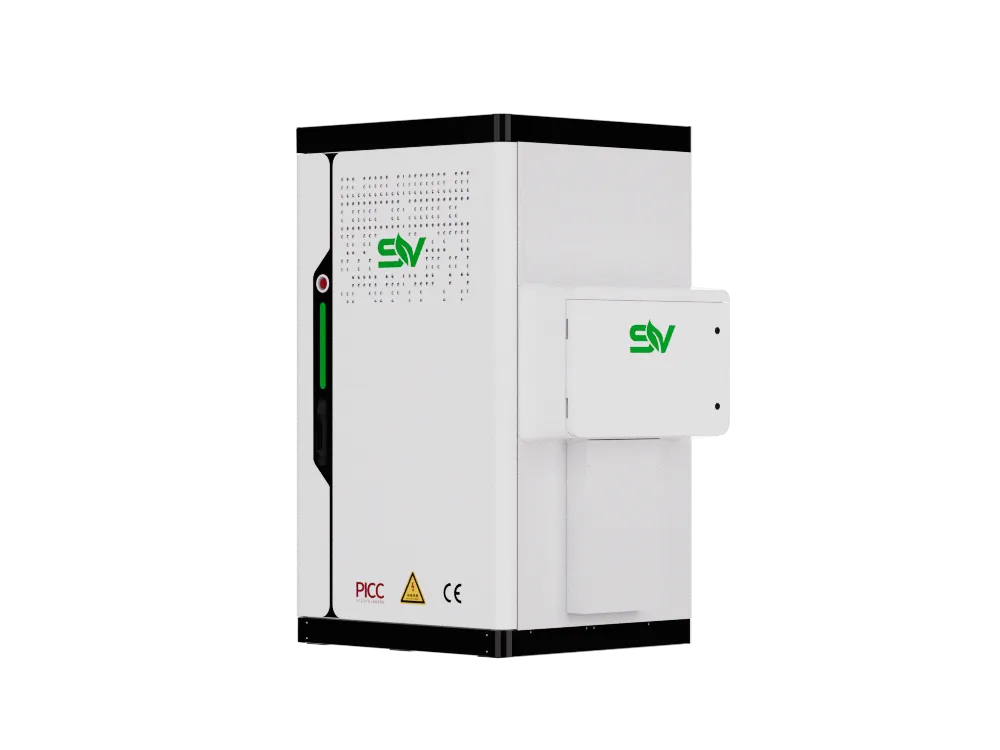
Technical data
| System | |
|---|---|
| Nominal capacity | 96 kWh |
| Cell type | LFP |
| Cooling | Air cooling |
| Form factor | Schrank |
| Efficiency (RTE) | 90 % |
| Grid & power | |
| AC power | 48 kW |
| Grid voltage | 400 V |
| On/off-grid switching | Yes |
| Direct PV input | Yes |
| Installation | |
| Dimensions (W×D×H) | 1150×1050×2000 mm |
| Weight | 1.4 t |
| IP rating | IP55 |
| Fire protection | Rauch- und Wärmemelder, Aerosol |
Technical data per the manufacturer's datasheet; binding values depend on configuration and project.
Storage Elf L1-6 — the balanced configuration
At 96 kWh and 48 kW, the Storage Elf L1-6 is the configuration that fits most commercial sites. It strikes the ratio most businesses need: enough capacity to absorb a full day of PV surplus, and enough power to release it again in the evening.
The typical case is a PV array of 70 to 100 kWp on a site with a steady base load and a pronounced evening peak. The storage system takes in whatever is not consumed directly during the day and then covers demand on site instead of exporting at feed-in rates.
Because the PV input accepts up to 70 kW, the L1-6 can often make a separate PV inverter unnecessary — the array is connected to the storage system directly on the DC side. Whether that works in a given project depends on string design and on whether an existing AC-coupled PV array has to be integrated.
The series at a glance
| Variant | Capacity | Rated on-grid power | Battery voltage | Weight |
|---|---|---|---|---|
| L1-5 | 80 kWh | 40 kW | 224–292 V | ≤ 1,270 kg |
| L1-6 (this page) | 96 kWh | 48 kW | 269–350 V | ≤ 1,380 kg |
| L1-7 | 112 kWh | 56 kW | 314–409 V | ≤ 1,490 kg |
| L1-8 | 128 kWh | 64 kW | 358–467 V | ≤ 1,600 kg |
All four variants share the same cabinet, the same footprint and the same 100 kW inverter. They differ solely in the number of battery packs — each pack contributes 16 kWh and 8 kW.
Where the L1-6 reaches its limits: at sites whose load peaks are well above 48 kW and occur regularly. Then the deciding factor is not capacity but power — and the L1-7 or L1-8 comes into view.
Configuration options
Two functions of the series depend on configuration and are not part of every delivery:
- Direct PV integration — the MPPT input for up to 70 kW of DC-coupled PV is listed as an option in the manufacturer’s datasheet. Below 438 V of string voltage the input operates with derating.
- Grid/island transfer (STS) — the backup power function is likewise listed as an option in the datasheet, while the manufacturer’s website describes it as a standard function.
We clarify both with the manufacturer before quoting. Either way, backup power is not a product feature but a project. Grid disconnection, protection equipment, load allocation, inrush currents and bridging time are assessed for each site.
Frequently asked questions
How much capacity and power does the Storage Elf L1-6 have?
96 kWh of nominal LFP capacity and 48 kW of rated on-grid power at 400 V. The system's maximum AC power is 100 kW. Binding figures depend on configuration and project.
How much space does the L1-6 need?
The cabinet measures 1,150 × 2,000 × 1,050 mm (W×H×D) and weighs at most 1,380 kg. The footprint of roughly 1.2 m² is identical across all four variants of the series.
Can a PV array be connected directly?
The series can take up to 70 kW of DC-coupled PV through an MPPT input, which can make a separate PV inverter unnecessary. The input is listed as an option in the manufacturer's datasheet — we confirm the scope of delivery before quoting.
Is the L1-6 suitable for backup power?
The series includes a grid/island transfer switch, which is part of the delivery depending on configuration. Even then backup power remains a planning task: grid disconnection, protection equipment, load allocation, inrush currents and bridging time are assessed for each site.